

NetSuite Pricing in 2026: How to Build a Scalable ERP Budget
WB
WebBee Team
eCommerce Specialists
The usefulness of the NetSuite ERP is widely recognized across industries. Over the time, NetSuite evolved as the most valuable cloud ERP solution for businesses of all sizes & niches. It is not just robust & extensive, but highly flexible, expandable, and customizable according to business budget & requirements. If you are looking for NetSuite Implementation, it is essential to analyze your needs, so that you can pick the right NetSuite pricing structure for your business. The use of Netsuite has increased as it lessens operational costs. Also, the competitive edge over business service or product rivals is led by cloud-powdered automation.
Moreover, the pricing plan of Netsuite is as powerful as its solutions. The software can be utilized for different businesses, so it might be possible that packages can be varied. One more thing is that Netsuite is not only for big enterprises, but it can be used by Startups or small businesses, so that they can focus on key areas of their business. In this blog, we will help you to understand different price plans of netsuite erp pricing 2026, along with implementation cost, so that you can choose the right plans that suit your business.
ERP pricing methods can differ from vendor to vendor, making direct comparisons & price estimates tough. But, many ERP vendors' costs depend on some universal element, involving business size, estimated no. of users, licensing terms, & more. Also, most ERPs can be prepared with customizable modules & functionality, at different prices, that offer business owners with the unique tools they might require to operate their operations in the right way.
To understand the price plans in detail, there are some terms that you should know. These terms will assist you in getting insights about it as we explore NetSuite pricing options.
Knowing the factors that affect an ERP system is essential. It offers business owners the information they require, so that they can compare quotes from different vendors and then choose the right balance between cots & perks. Let’s explore 7 common factors that influence ERP pricing.
The type of the business, involving its structure & size, find out the features and no. of modules that business need in its ERP system. Also, additional features will increase the price.
Number of users is the main licensing element for identifying ERP cost. It mainly depends on concurrent or named users. The named strategy restricts businesses to put a hold on the no. of specified accounts, no matter how much employees are utilizing it at the given time.
ERP systems basically meet few requirements of the businesses. The flexible NetSuite ERP system can fulfill remaining news of the businesses, but for that they need to customize their system. And when they go for customization, it will add cost to an ERP launch.
ERP vendors utilize various Netuite pricing models. So, based on that few charge flat rates, others may charge per user depending on the features & modules integrated into your system. And few may charge on the basis of transactions processed at a given period.
Organizations and employees should know their system's ability to increase its benefits. So, vendors should provide training to a user’s employees, in order to make it easy for the IT team to execute & control the ERP, so that it can be used by other staff to improve their work.
While the primary ERP system might provide the key features businesses require to effectively handle operations. But, additional cost add-on modules can improve unique areas, like inventory or warehouse management.
Most vendors of on-premises ERP systems utilize their own processes to identify which OS and database software operate best with their platform.
NetSuite provides packages for companies of any size. But NetSuite Suite is classified into 3 editions. Let’s look at them.
A General Ledger in the ERP monitors all the financial transactions. If you want to generate financial statements for your business, then it will help you to complete the task.

It is a basic practice followed by the ERP development services to choose any one from named user or concurrent user licenses. You need a user license if you are a:
1. Director
2. Master Controller
3. Customer Service Executive
4. Manager
Each Suite in NetSuite needs user licenses to deal with the system. There is a complete user license that is provided to the staff who deal with it regularly. This license operates on the
subscription model. The minimal period is 1 year & you can increase or revive the subscription at an appropriate time.
Just equivalent to the specific features of the business, one might need less or more than the basic Netsuite CRM & ERP features. The primary package that you select will have the required features that will support your business workflow. But sometimes companies need additional features that are not present in your base package. So, here comes the advanced modules such as FMS, inventory management, Human capital management, & more which will add against your NetSuite licensing costs.
NetSuite provides companies 3 complete integrated solutions for e-commerce based services.
1. SuiteCommerce Advanced
2. NetSuite Site Builder
3. SuiteCommerce Standard
The ideal part for these solutions is that they are not different. It means you will get these items as a separate entity. They are linked not only to ERP but also to CRM, when you subscribe for any package.
The initial tasks of configuring NetSuite are over. Here comes the important part of the journey which is referred to as the implementation stage. This consists of separate costs based on the needs, time period, business complexity, & more.
There are various stages in executing NetSuite for your business. Every stage has its own time period including clinical tasks to find out and offer automated solutions for the challenges faced by the businesses earlier.
Stage 1: Discovery
The range of implementation is identified at this stage. The time period for verifying the workflows varies from business to business. The professionals should do in-depth evaluation of each section of the process to obtain useful insights. It will help them to offer an ideal solution.
Stage 2: Design & User Acceptance
This is an essential stage and it is said to spend more time with the execution team during this duration. This stage will help to set up the needs and offer services with several advanced modules. At this stage testing is also done and after user acceptance, we will move to the next stage. For the design process, you may require customizations.
Stage 3: Integrating the ERP Platform
The system will get integrated with your staff. Right training and hand-on experience will be given department-wise to understand it better. And simultaneously, full user licenses & critical licenses training given to them. Once you are done with the training, the system is ready to utilize all the features and the organization is under NetSuite support and guidance for many of the core functionalities.
Simplify B2B eCommerce Sales with Robust NetSuite Integrator
Stage 4: Implementation Process
NetSuite can be easily linked with any top application. Due to the design style correct from the starting as flexibility is the main aim behind the launch of the platform. The 3 top options one can link NetSuite with other apps are:
You can look for these preferences if your organization needs such services.
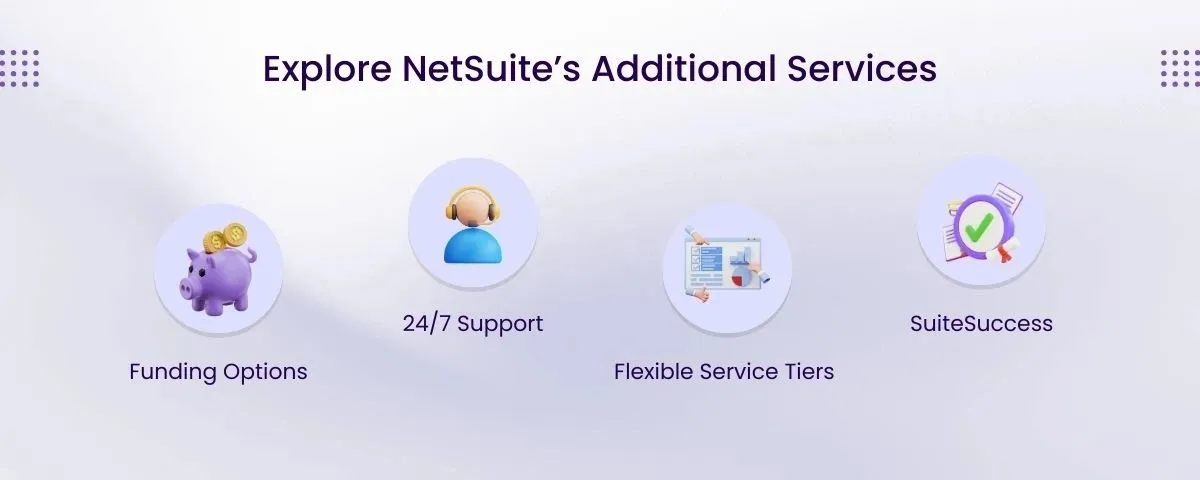
NetSuite providers offer fintech options for subscribing to any NetSuite package. But, the credit score should be good enough so that the provider can take your request.
It offers free user support, and if you wish to convert it into 24 by 7, you need to upgrade your plan. NetSuite price based on the contract value. Even for connecting a service provider for tech needs, you require to pay extra cost.
Mainly for big enterprises, NetSuite provides unique offers in terms of flexibility and database storage. If you want more control and scale at a fast rate, look for Netsuite premium plans.
It is a product provided to businesses to go live with NetSuite. As it comes with loaded KPIs, & reports, that are personalized for your company. You can verify with experts if your business needs this product.
NetSuite is not the budget-friendly ERP on the market, and even it doesn't want to be. It provides a level of scalability, flexibility, & cross-functional clarity that some medium platforms can match. For organizations that are handling multiple systems, manual processes, merging onto NetSuite can offer operational gains and many more benefits.
WebBee operates with businesses that use ERP as a long-term platform, not a short-term project. We provide NetSuite implementation solutions across industries, involving SaaS, logistics, retail, & more where automation, scalability, and multi-entity corporation are essential.
So, if you are not sure how much NetSuite will cost your business, talk to our NetSuite experts and we offer a tailored breakdown of NetSuite erp pricing depending on the industry, structure, & objectives.
.svg)