

Inventory Made Simple: 5 Must-Follow Steps Every eCommerce Seller Needs
WB
WebBee Team
eCommerce Specialists
Inventory is the key factor for the success of any business, ensuring the correct balance between demand & supply. The inventory management process involves five critical steps that, when appropriately executed, result in smooth operations & better user experience. But in reality, it can be challenging to maintain this balance. As per the US Census Bureau, the US retailers book $1.26 of inventory for each $1.00 of items sold. It is even worse than overstocking when you are not able to meet users' demands. So, making a practical inventory management approach is the route to developing a growing e-commerce business that results in a streamlined supply chain. In this blog, we will explore the benefits, best practices, future AI trends, and five essential steps that make the inventory management process smooth & effective.
Inventory management is a structured practice of monitoring and managing a company’s stock. It includes everything from storing them to ordering to tracking orders to fulfilling them as soon as possible, reducing inventory access, & avoiding stockouts. Reports show that 34% e-commerce businesses have gone through situations where they have sold unavailable products from their inventory, resulting in understock or overstock problems for themselves and influencing revenue. Businesses that execute a smooth inventory management process can reduce such issues with better inventory planning.
When you know & trust your inventory details, it can assist eCommerce Sellers to remove the most common inventory issues. Let’s look at the benefits of having precise inventory in e-commerce.
Data-based insights from inventory management offer you marketing and buying approaches. If you want to see which product is gaining popularity, you should focus on that throughout the season. You can do it by looking at previous data when seasonal sales start.
When you have the correct inventory, it will eliminate the requirement for big purchases, resulting in saving capital. So, to avoid overspending, it is essential to have complete control over inventory.
Streamlining inventory levels helps to reduce storage carrying costs and avoid dead stocks.
With efficient order fulfillment and preventing stockouts, you keep your users satisfied. Backorder issues or understock, receiving the wrong product, and late delivery are the common factors for negative e-commerce reviews.
Knowing the kinds of inventory in your e-commerce business enables you to plan more accurately for resource allocation. Let’s explore different types of inventory.
● Work-in-progress: Goods that are under manufacturing.
● Raw materials: Simple inputs needed for production.
● Finished goods: Available-for-sale inventory.
● Deadstock: Useless items that need to be removed.
● Safety stock: Buffer stock for high demand or supply issues.
Inventory analysis approaches such as ABC analysis, Just-in-time inventory, cycle counting, & more, planning is essential for unfiltered visibility and correct inventory segmentation.
For maintaining inventory level, you need to follow these five essential steps that keep your stock on track. Let’s explore them in detail.
Apart from their eCommerce order management, businesses do deep research about market trends and previous data to precisely forecast future needs, offering a strong basis for informed decision-making. The process consists of making the right choices with regard to your inventory level to timely deliver to satisfy user needs.
The buying and ordering process starts once you identify what is needed. This stage includes obtaining products from suppliers and managing the complete order journey. For e-commerce businesses, mainly essential for implementing proper buying practices, reselling products is the route to creating strong profit margins.
After the purchasing stage, the focus moves fastly toward getting, storing, & packing stock. The information of these differs based on the seller model, whether it is a 1st party model, 3P, or a hybrid approach. Businesses can increase efficiency by utilizing model-based practices, showcasing storage solutions, allowing products to reach users precisely while maintaining high-quality benchmarks.
Reasonable inventory control needs to track inventory levels in real time, monitoring stock movements, making changes as required, & taking actions to solve any issues. Strong tracking techniques are essential for the right financial reporting & streamlining overall operations.
Order fulfillment is an essential part when we talk about customer satisfaction. The phase involves several tasks, from picking to packing orders to generating strategic decisions on shipping. Companies should give priority to this stage for higher efficiency. SMEs go for 3PLs perfect, providing customization, cost-effective, & flexible.

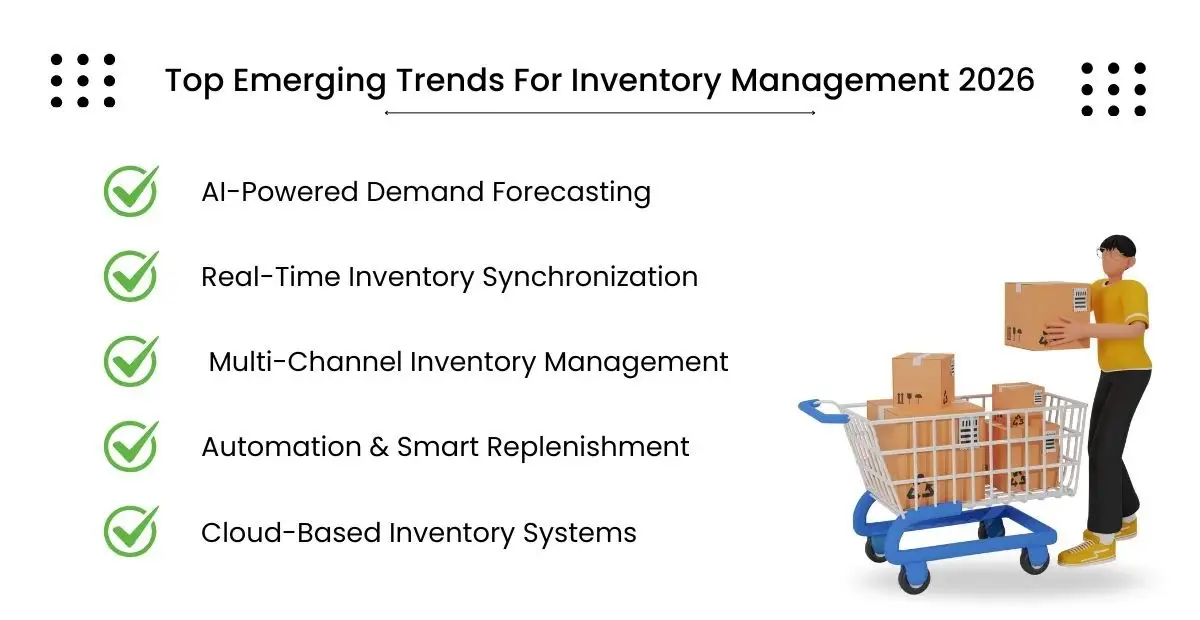
To empower your inventory management, you should look for integrating inventory management software, ERP, and cloud-based tools to unite supply chains and automate reordering depending on real-time data. Advanced tools such as mobile scanning and future AI trends not just improve accuracy but also allow dynamic warehouse streamlining and cycle counting.
1. Keep it easy to site and effectively handle your items by showcasing a systematic arrangement system for them.
2. Consistently updating your inventory levels to highlight exact stock levels and prevent discrepancies.
3. Staying coordinated is the establishment of effective stock administration.
Advanced warehouse tools like real-time analytics, computer vision, and more, help to reduce errors & uplift operational efficiency. Using these innovations will offer businesses a competitive advantage in handling inventory.
AI-based robots manage receiving, picking, & reorganizing, while automated drones do real-time audits, changing warehouses into innovative fulfillment centers.
Generative AI enables replicating scenarios & robotic reports, while NLP enables employees to interact with systems by using text or voice, enhancing communication & insights.
Modern ML models forecast demand with better accuracy, maximizing stock levels & reorder points by evaluating tough variables such as trends and seasonality.
A thriving business fulfillment center is due to effective inventory management. Companies can improve operational efficiency, reduce costs, and engage users by following the five critical steps we mentioned in our blog. WebBee, an e-commerce integrator platform, helps businesses with smooth integrations and powerful inventory automation abilities that work best with the advanced demands. So, if you are handling a hybrid approach or 3P/1P or expanding globally, We assists you in streamlining operations across all platforms and upgrading your inventory management for high performance. With real-time tracking, channel integrations, and a team of experts to help you achieve your objective, WebBee integrations is your one-stop solution for inventory management and more. So, why wait? Reach out to us.

.svg)